I would wager, with just days before the 2026 season opens, few teams in MLS had a bigger glaring need than Minnesota United did at right back.
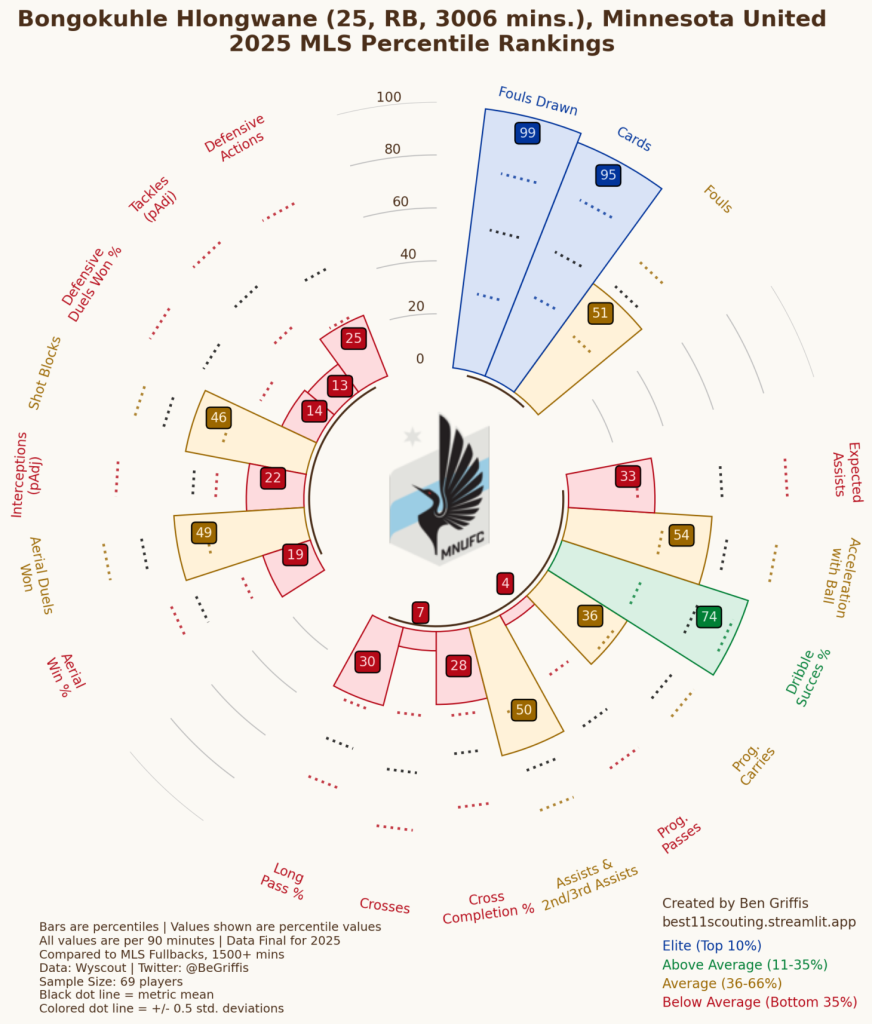
The problem is worse than it might seem at first blush. Yes, there are three recognized right backs on the roster — Jullian Gressel, Bongokuhle Hlongwane, and D.J. Taylor — but Gressel is moving to midfield this season, Taylor was always a limited player and has only gotten moreso, and Hlongwane was badly miscast in that role last season. It wasn’t his fault, but it was not an experiment to be repeated.
Everyone wanted Bongi to succeed there, and there were moments where it seemed like the move might actually work, but the radar tells the story of a player who was giving his all for the team but not getting much reward for his effort.
As I detailed here, without a two-way player on the right, the Loons were going to struggle to find a formation that worked. And with much of the team’s leadership talking about a more offensively minded team, that was going to come with a serious trade-off on the defensive side without Dayne St. Clair in net to bail them out.
So Minnesota made the correct decision and brought in a new right back, 28-year-old Kyle Duncan. This is not a move that will turn heads. This is not a sexy move. This is not a move that illustrates new ambition or commitment to competing for trophies.
It is, however, a very good move.
Duncan is a former NYRB fullback and full Jamaican international, who played briefly in Belgium before coming back to MLS. If that oddly specific profile somehow sounds familiar, it also describes former Loon Kemar Lawrence; Minnesota will hope for better results this time around.
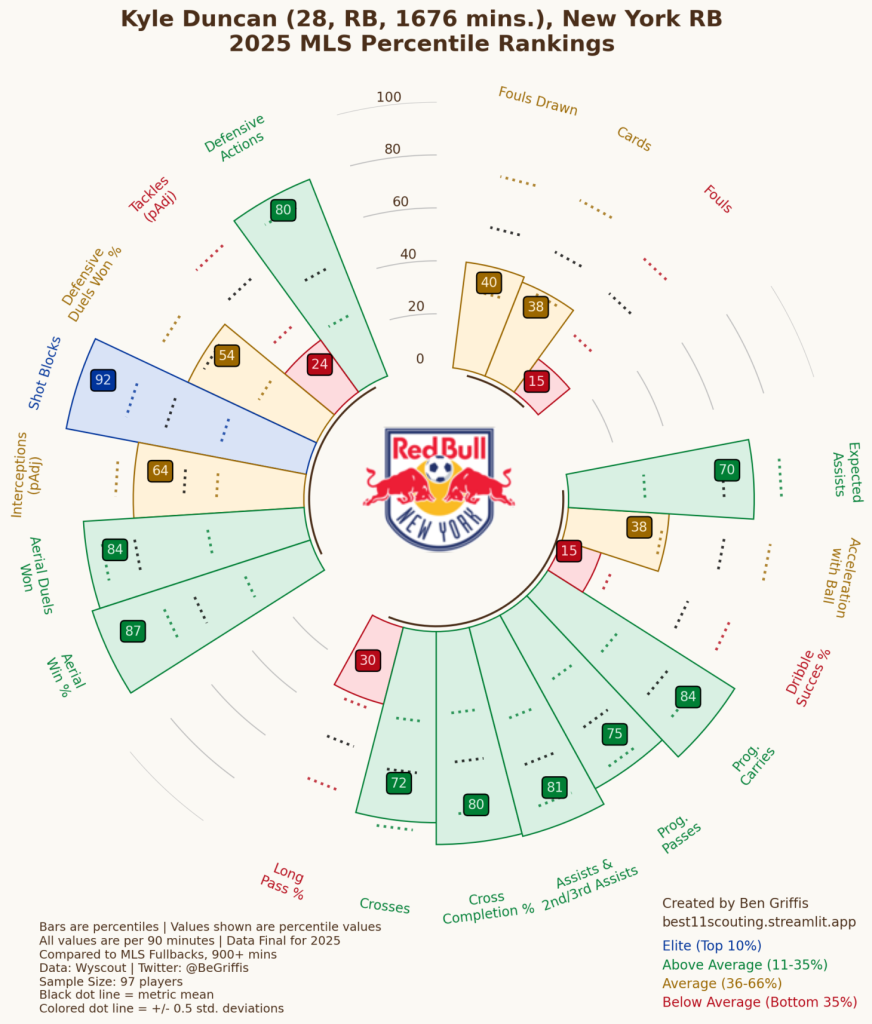
As you can see, Duncan doesn’t have one single standout skill, but he does most things you want a fullback to do at an above-average level. He’s better offensively than defensively, but hardly a liability against opposing attackers. Tackling is a weakness and he was dribbled around by attackers more often than average last season, but rotational defending was one of the things the Loons did particularly well in 2025. They should be able to cover for him if necessary.
On both sides of the ball, Duncan will help the team hold its width, which should allow James Rodriguez more space to operate irrespective of what formation the team eventually settles on. Here’s his heatmap from last season when NYRB typically played a 4-2-3-1, as well as his passing habits, courtesy of American Soccer Analysis’ VizHub:
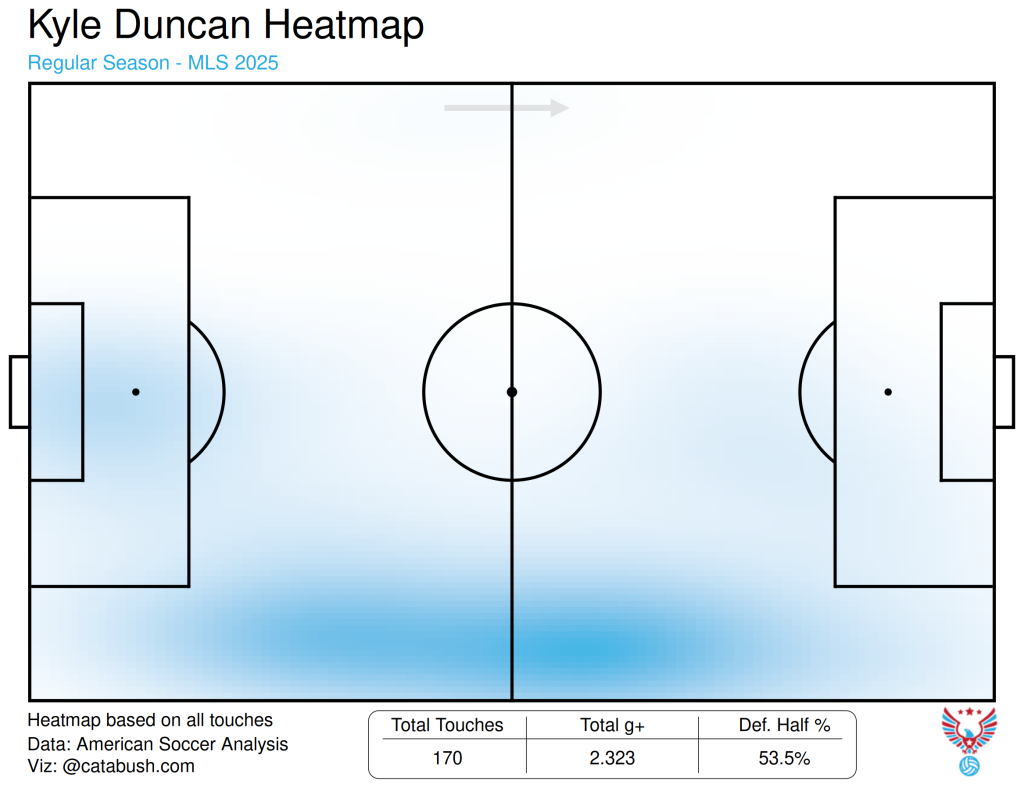
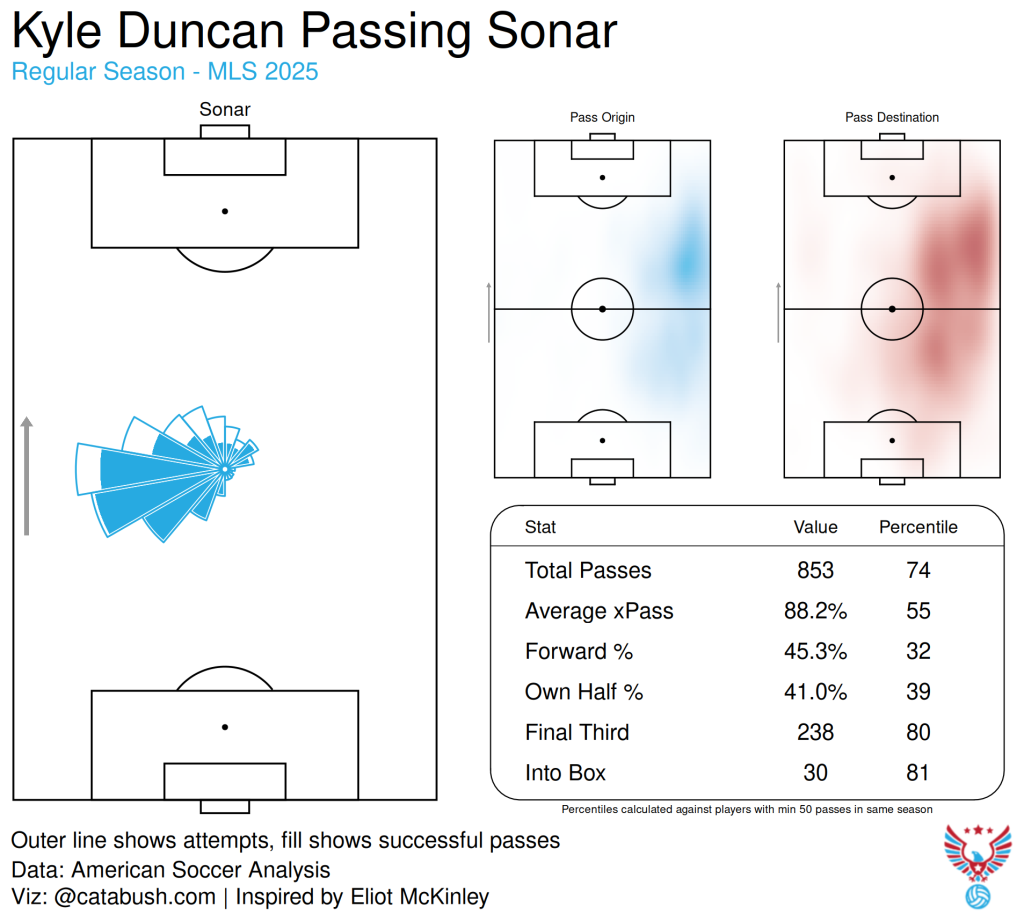
Offensively, Duncan isn’t a fullback that will get to the endline and cross into the box from there or make a lot of overlapping runs. He’s at his best when he’s progressing the ball up the wing and finding either a central midfielder inside of him to recenter the ball for the attack or an attacker further up the line.
That profile should match just about perfectly with Wil Trapp, James, and Bongi. In fact, however Cameron Knowles chooses to push the Loons into attack, Duncan should be a strong instigator after a turnover in the defensive third. If defenders don’t step to him as he progresses the ball, preferring to cut off the passing lanes on the ground, Duncan’s crossing is good enough to bring Kelvin Yeboah into the play and force defenders to rotate while backtracking.
Loons fans won’t confuse Duncan with Alex Freeman, Mathias Laborda, or any of the other marquee right backs in MLS; he’s good, but doesn’t have quite the same game-breaking ability they do. Assuming he performs similarly in 2026 as he did in 2025, he’ll likely be above-average, but outside the top 10 at his position.
This isn’t meant to be damning with faint praise, but if he performs at that level, he’ll be — at worst — the second-best right back in Loons history. The drop-off after Romain Metanire is steep. Incredibly steep.
A former player once told me that during his negotiations with a certain front office, they’d point blank told him he’d risen to the top of their list because he’d played particularly well against them. I don’t think that’s why the Loons got excited about Duncan, but if it were, no one could blame them: In the 2-2 draw between Minnesota and NYRB last season, Duncan had the best game of any right back in MLS last season per SofaScore.
He may not repeat that feat this season, but the gap between Duncan and the players he’ll be replacing is wide enough that he’ll feel like a high-impact acquisition without being an attention-grabbing signing.