
I touched on this in the my piece on whether the Loons were a good team that was catastrophically unlucky or a bad team that played pretty close to their expected level, but Minnesota United either needs to have a very busy offseason or can afford to be picky and add 2-3 high-impact players. I’m still not sure which it is.
Statistically speaking, they’d been playing like a good team but not getting the results for most of the season, if you believe futi/American Soccer Analysis’ model of goal contributions*. If that is indeed the case, then going seven unbeaten isn’t that surprising. If Minnesota is the team that looked lost trying to do anything more complex than take a throw-in, then the illusion of competence simply came together at the best possible moment – albeit slightly too late.
The thing that makes me believe that the end of the season wasn’t an aberration and that the front office can move forward in the belief that they need surgery not surgery-by-chainsaw is the timing of the improvement. Cherrion Valerius started seven games, the Loons moved to a straightforward back four, Shoresy. Morris Duggan told Andy Greder that the move allowed the team to simplify their defensive assignments and limit switching, which was clearly an issue on a number of the goals they allowed.
With Valerius, Duggan, Jefferson Diaz, and Anthony Markanich all under contract for next season, it’s safe to assume Minnesota will stay with the back four in 2027. With Owen Gene and Nectarios Triantis undefeated as a midfield pairing, it’s reasonable to assume they’ll be back in the same roles next season as well — the only reason they wouldn’t is if one of them is sold in January.
So six outfield spots are spoken for, leaving four to be filled and a formation to be selected. My assumption had been that they would move to a 4-2-3-1 and go after a true #10 central attacking midfielder this winter. After taking a closer look at their last two wins, I’m less sure that’s what they’ll do.
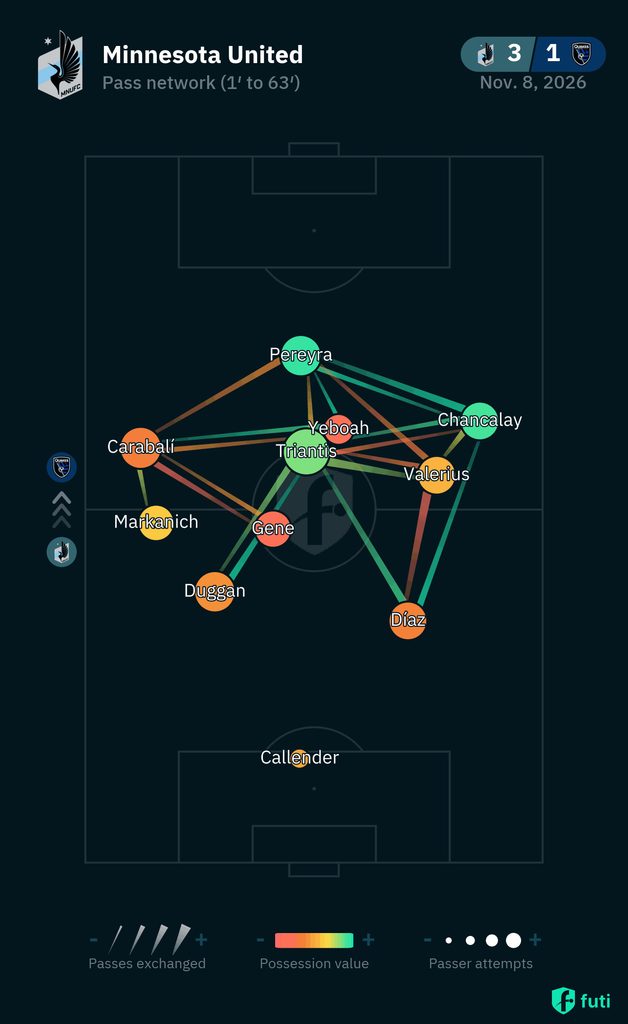
When they moved to the back four, Minnesota opted for a 4-4-2 with Joaquin Pereyra starting up top alongside Kelvin Yeboah, though Pereyra wasn’t doing striker duty… or was he? Against LAFC, he and Yeboah were in close contact but against San Jose, Yeboah was the one dropping deeper.
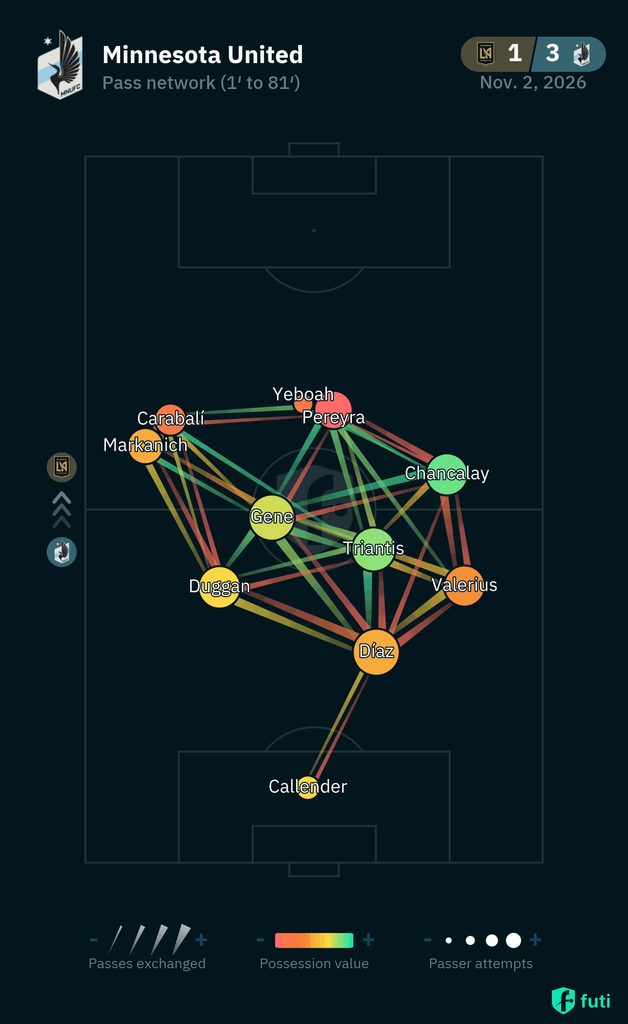
In their game against LAFC, Minnesota dictated the play for the first half, then sat back and absorbed the pressure in the second. It was the type of game where Pereyra would normally take quite a bit of the ball and facilitate, but — perhaps because it was his first start in over a month — that was not remotely the case. Seven of his teammates had more touches, he created just a single chance, yet he was critical to keeping attacks alive and scored 40% of his goals for the season.
Against San Jose, Pereyra still had the most touches of any Loon, the most chances created in the game, and the most line-breaking passes, but the progression from the middle third to the final was triggered by Triantis, Duggan, and even Tomás Chancalay rather than Pereyra. So while he was certainly getting forward, it was in a true hybrid role rather than either purely a striker or central attacking mid.
As much as I like this hybrid theory, I’m not sure it’s sustainable over the course of a full season because it requires multiple other players to be comfortable triggering breakouts, moving the ball out of the defensive third, and orchestrating quite a bit of movement as the play shifts in addition to their normal role. As a change of pace, however, it’s clearly effective.
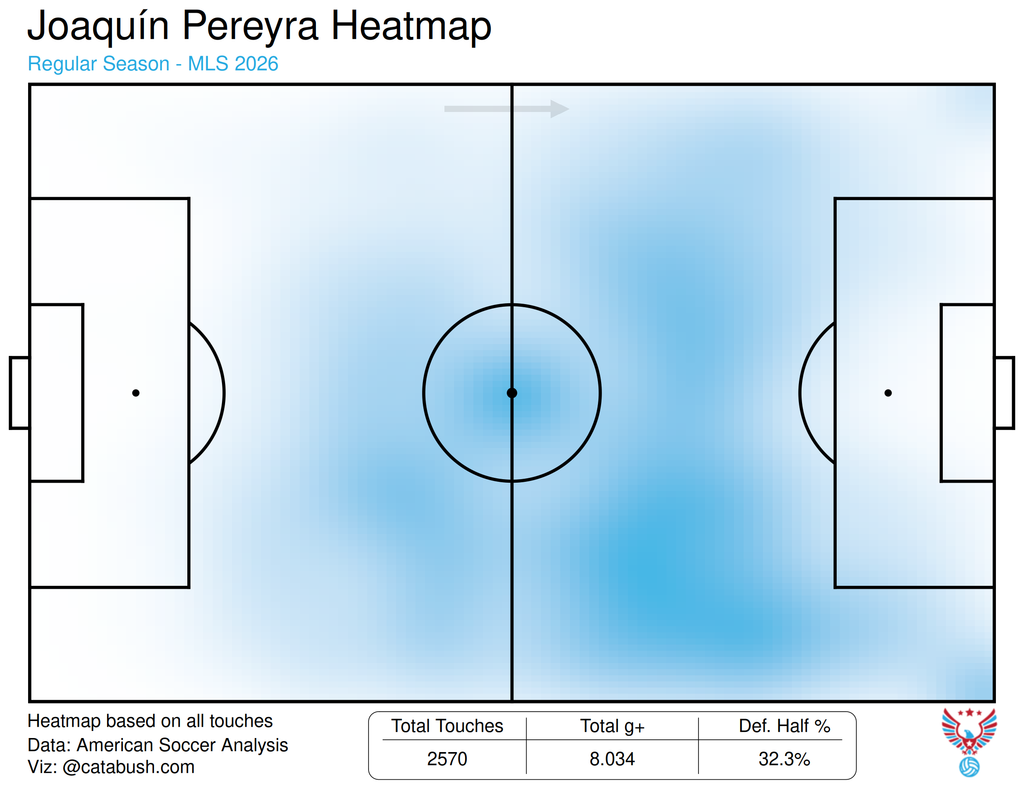
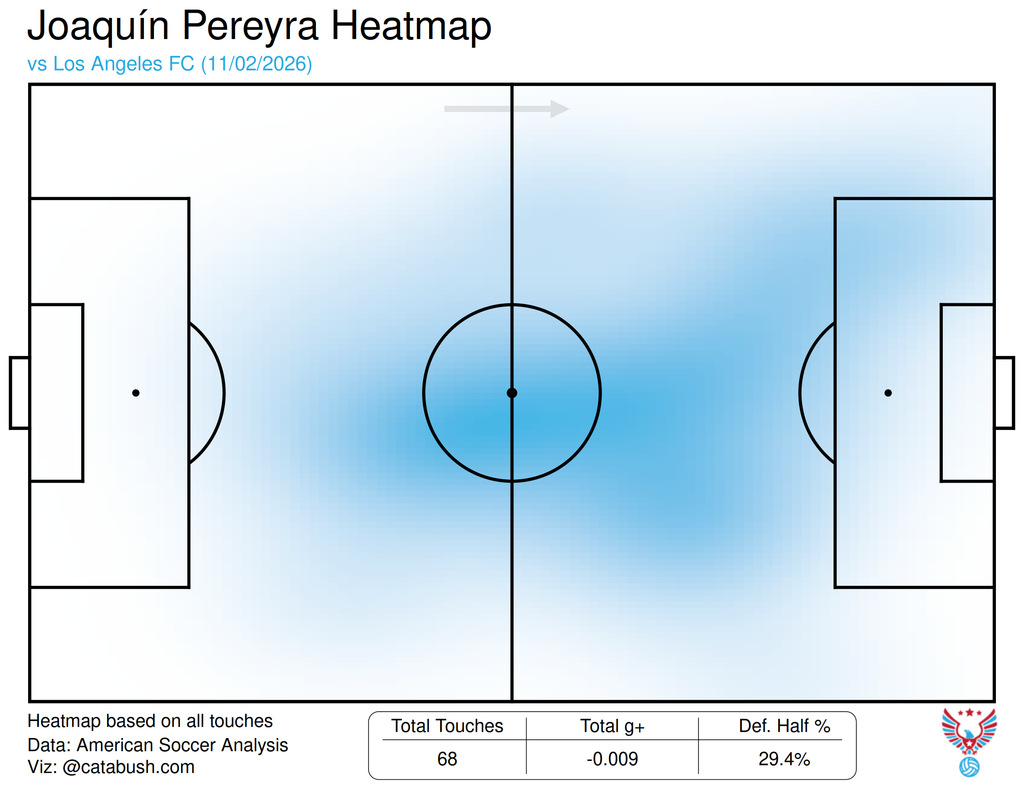
The move into the top left spot also allowed Pereyra, a left-footer, to fade to the left touchline rather than the right where he had spent most of the season. Compare his full season heatmap with the map from his last two games from American Soccer Analysis’ VizHub.
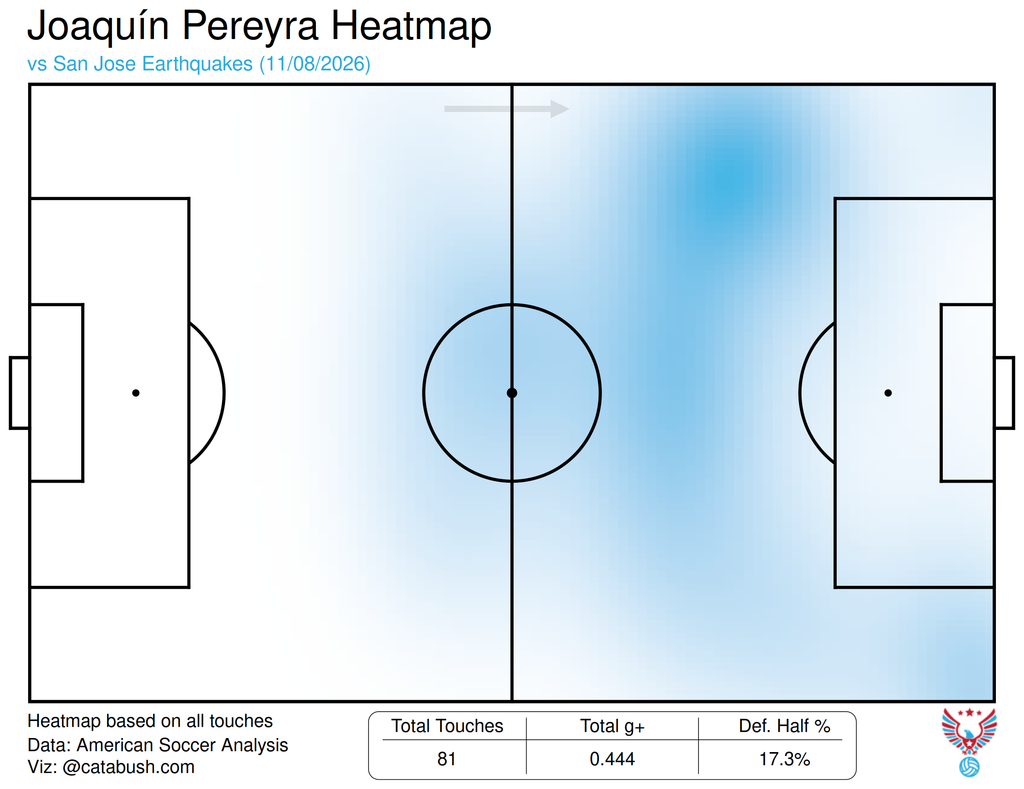
This is particularly interesting given who the Loons targeted in the last window: Callum McCowatt and Cătălin Cîrjan, both right-footers that dwell on the left and cut inside. McCowatt is likely off the table entirely now, having moved to AGF at the end of the summer window, but Cîrjan was expected to be one of the Loons’ targets this winter.
Further complicating that move now is that Cîrjan’s role has changed as well. Dinamo Bucharesti also moved to a 4-4-2 and also moved their primary facilitator from the midfield up top. He’s still highly influential, but he looks less like the central attacking midfielder he did for last season and feels a bit redundant unless Minnesota thinks he can play as the left midfielder in the
4-4-2.
In a perfect world, I would love to add a second Pereyra who was four years younger than Pereyra Prime. Budgets being what they are, it seems like not the best use of resources, unless the team is really only looking at bringing in 1-2 starting-caliber players because the talent on-hand is good enough to challenge for trophies.
At that point, they could spend the money earned by the sale of Tani Oluwaseyi and the salary freed up by Julian Gressel’s departure on a true left wing and still have plenty to bring in someone like Cirjan, who is both an asset this season and should continue to improve for the next several. That’s how good teams continually get better, but it only works if Minnesota doesn’t need to bring in the 3-4 starters it looked like they needed over the summer.
*I think it’s the best publicly available model, though I do have weighting questions. Someday, I’ll have the brain power again to dig into it.