Minnesota’s first week back after the World Cup break was underwhelming to say the least. Wednesday’s 2-1 loss to Kansas City was among the Loons poorest performances since the departure of Adrian Heath, and while Saturday’s 0-0 draw with Vancouver was certainly better, it was still less than good.
Wednesday’s absolutely dreadful loss to the cellar dwellers would be reason enough to hit the transfer market like it was the last game in Supermarket Sweep. But even if they’d slipped in a last-minute goal and drawn, the first 65 minutes of utter futility should be enough to set off alarm bells all over the office.
As Jon Marthaler put it, the dashboard on the Loons’ car should be terrifying.
It’s worth noting that some of the issues from that won’t persist. The Loons struggled to get back-to-front when they recovered the ball in their defensive third, something Nectarios Triantis – recovering from surgery, but back in full training – excels at.
Their backline was a step slow — Michael Boxall’s denouement is clear and something the team should be prepared to handle — but that was exaggerated by the fact that Kansas City had played the week before and were closer to true game-pace than Minnesota was. Carlos Harvey was back against Vancouver and Nico Romero shouldn’t be too much further behind.
Kyle Duncan, who has become critical to Minnesota’s attack, looked uncharacteristically off the pace. After a two-month layoff, perhaps the bigger surprise is that more of his teammates didn’t look similarly rusty.
Saturday in the sauna was a much more characteristic Loons match. They switched back to the 5-3-2 that served them well last season and, much like last season, ground the game to a halt. Neither team created a big chance; it was the first time this season neither Minnesota nor their opponent manged to create a big chance this season and the first time since last year’s incredibly dire 1-1 draw away to Colorado on Sept. 27, 2025.
The last four times the Loons have played the ‘Caps have split neatly into two groups: Minnesota plays out and loses by multiple goals or Minnesota plays back and holds on for a 0-0 draw. So while I didn’t enjoy Saturday’s dull sweatfest, I do understand it.
What I don’t understand is how Minnesota got to this point.
Nine games into the season, following their 1-0 win over Dallas, the Loons were tied for their best start in the last five years. They came home and played superbly against LAFC, even if they did lose. On May 2, they came from behind to beat Columbus, putting them on 20 points through 11 games — behind 2025’s pace, but only barely and still well ahead of every year from 2022-24. Since then, well, see for yourself:
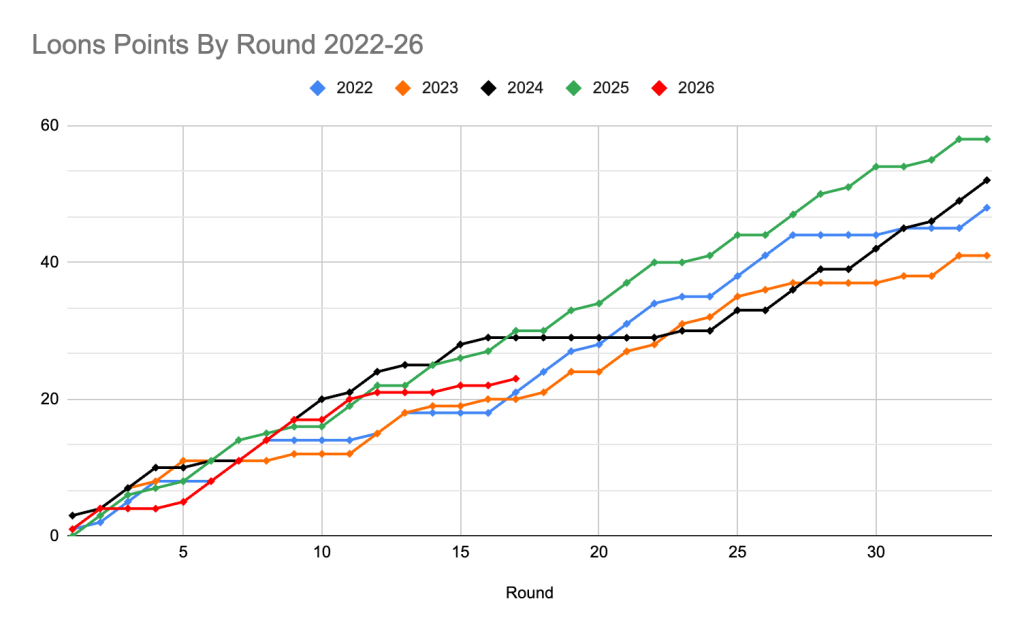
They’ve taken three points from six, their pace clearly dropping from feeling more like good seasons to feeling like the rather bitter end of Adrian Heath’s tenure.
Here’s what I’m trying to wrap my head around and they are, to me, the most critical questions the front office has to answer going into the transfer window.
- How bad has this stretch really been?
- Why is it happening?
Answer those two questions correctly and the plan heading into the second half of the season and the transfer window becomes much clearer.
How bad has this stretch really been?
The last six games have been beyond frustrating. Minnesota has scored five goals total, multiple goals just once, and seldom looked like there was a cohesive plan in attack. Defensively things have been better, but not good enough to pull out 1-0 wins.
Below is a table of the last six games with the opponent, home or away, and result.
| Opponent | H/A | Result |
| Austin | Home | Draw |
| Colorado | Home | Loss |
| New England | Away | Loss |
| RSL | Home | Draw |
| KC | Away | Loss |
| Vancouver | Home | Draw |
Immediately, three results jump out as not being worth getting too worked up about in and of themselves. New England is one of the best home teams in MLS, that loss isn’t a bad result. Vancouver is the joint-best team in the Western Conference, a draw isn’t a bad result. RSL has been very good this season, and while that’s the kind of game Minnesota should win if they’re a very good team, too, a draw isn’t a horrible result.
As considered above, if the KC result is due to rust, that’s not something a team should be making forward-looking decisions based on. It’s a very bad result, but not an actionable one.
That leaves just two in this stretch of six without a win that should give the front office serious pause: two bad results, both at home, to teams below Minnesota in the table. But as we all know, overreacting to a few bad results, even consecutive ones, is a great way to mess up a promising season. So let me add a little bit of color to that table:
The new column is futi’s deserved win metric, a reflection of underlying stats like their advanced expected goals model, which includes things like possession value. I have it listed here always as MIN-Draw-Opponent; the most deserved result is bolded.
| Opponent | H/A | Result | Deserved Win Spread |
| Austin | Home | Draw | 55-24-21 |
| Colorado | Home | Loss | 38-36-26 |
| New England | Away | Loss | 43-29-28 |
| RSL | Home | Draw | 50-37-13 |
| KC | Away | Loss | 37-26-37 |
| Vancouver | Home | Draw | 39-38-23 |
Anything stand out? Maybe something unexpected during a six-game winless streak? Maybe that Minnesota deserved to win all six of the recent games they’ve failed to?
Stating the obvious: Based on these numbers, that Minnesota only has three points from this stretch is a wild outlier. Based on what’s here, Minnesota is still a good team that can be expected to right the ship very, very soon.
Even seeing this and believing the underlying data, there’s a part of me that’s very skeptical that it accurately depicts reality.
Against Vancouver, Minnesota’s best chance was actually only the second-highest xG chance they produced. At the end of a very nice back-to-front move in the 19th minute, Joaquin Pereyra hit a long switch to Anthony Markanich, who popped up a looping header toward Momo Dieng. The ball bounced awkwardly between Vancouver’s keeper, Yohei Takaoka, and Mathias Laborda, allowing Dieng to muscle past Laborda and get a shot off from inside the six-yard box. Takaoka had tracked the ball well and had his whole body behind Dieng’s shot, which caromed out for a corner.
That xG of 0.17 but an xGoT – the expected value of the shot discounting blocked shots and shots that miss the frame entirely – of 0.61. In general, I can see how a shot from there would be highly effective assuming the shooter can hit the frame, so I don’t think that 0.61 is wrong writ large, but given how slowly the play developed, I don’t think it accurately represents the actual probability of scoring off that specific sequence.
Dieng did the things he was supposed to do, but the ball only travels so fast, and Takaoka had more than enough time to get into position.
Meanwhile, the Loons’ actual highest xG chance came off a breakaway in the 82nd minute. A 2-on-2 move broke down after Tomas Chancalay couldn’t get into a good position for Dieng to find him, and after recycling the attack, Dieng flipped a cross toward Devin Padelford who was fronted effectively by Nikola Djordjevic. Padelford did well to get his head on the cross at all, but sent it well off-target.
Nevertheless, his xG was 0.23. Once again, I think over the course of all shots from that position, about a quarter do go in; I do not think Minnesota gets 23 goals given 100 chances from the point Pereyra released Dieng over the halfway line.
So how bad has this stretch been? Less bad than it has felt, I think that’s safe to say. If you believe the underlying numbers more than I do, there’s reason to believe that without substantially changing anything, goals will start going in again. It’s a swoon, and with plenty of time left in the schedule it’s more inconveniently timed than worrisome.
Why has the bottom seemed to fall out on Minnesota?
Like last year, they struggle when opponents give them the ball. When the Loons have 50% or more of the possession, they are 1-2-5; when they have 49% or less, they’re 5-2-1. Not coincidentally, five of the Loons’ last six saw them being forced to keep the ball. Teams have gotten wise to the fact that while Minnesota’s formation from last year has changed, the mentality mostly has not.
But possession isn’t inherently bad, just ask newly crowned World Cup champions Spain, so why is it part of what’s causing the Loons to underperform? The loss to Kansas City was a perfect illustration.
I mentioned above that Triantis’ absence meant that Minnesota moved back to front more slowly than usual. The result of that was instead of the Loons attacking defenders on their back foot, either backpedaling or facing away from their goal, Kansas City could set up a low block and wait for Minnesota to arrive in the attacking third.
The crowded defensive zone blunted Minnesota’s attack in two key ways. First, neither of Minnesota’s starting fullbacks thrive as crossers and being forced into that role means they’re unable to do the open field attacking they’re both much better at. To wit:
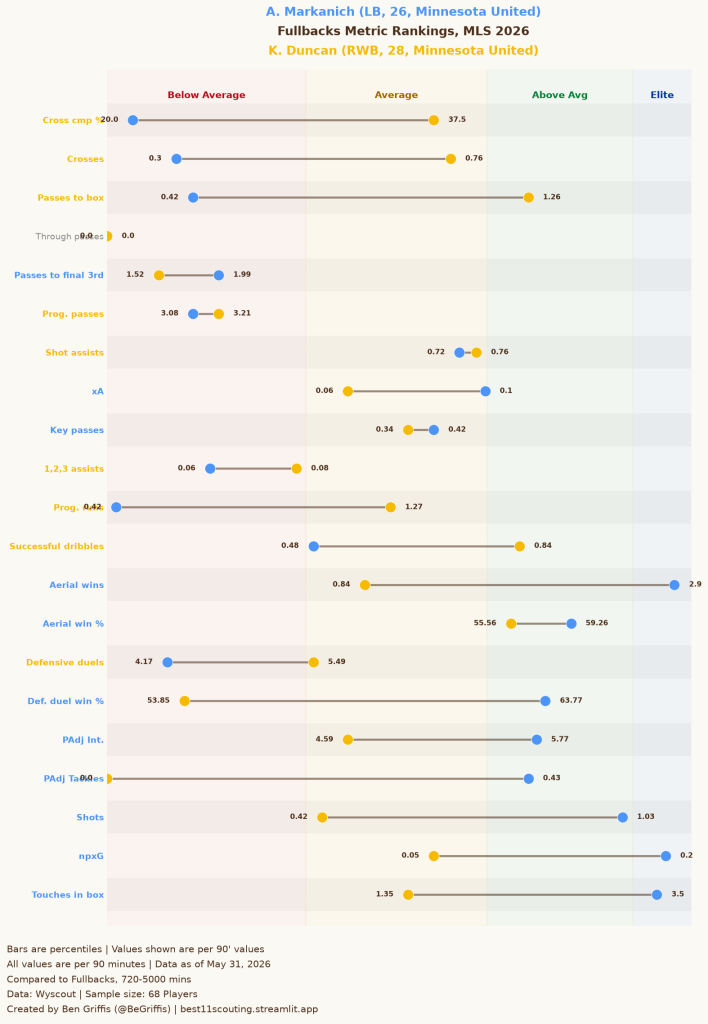
Second, and perhaps most importantly, crowded boxes mean there’s nowhere for Yeboah to move to get open, which means the whole offense stagnates.
With Kelvin Yeboah on the pitch in KC, Minnesota took seven shots, four in the first 15 minutes and just three between the 15th and the 63rd when Yeboah was subbed off along with Kyle Duncan in favor of Dieng and Bongi Hlongwane.
Of those three shots, one was on target, one was off target, and one was blocked. From the 64th on, Minnesota took nine shots: seven on target, one off target, and one blocked.
This doesn’t mean that Yeboah is inferior to Dieng and Hlongwane, I don’t think that’s the case at all — unless one of the latter two remembers how to finish, then all bets are off — but it does mean that in cases where Minnesota’s opponent has settled into their defensive block, the coaching staff may want to err on the side of subbing in more chaotic attackers too early rather than too late. Or the Loons should go get an attacking midfielder. Or both.
If the underlying expected goals and deserved win stats communicated that Minnesota was about to snap out of this malaise, the possession and clear connection to the Loons’ weaknesses tell a different story.
There’s no reason to assume that any opponent, save maybe San Diego, is going to let the Loons sit back and counter-attack until they prove they can do something to break down a bunkered defense.
Getting Triantis and Romero back will help Minnesota, no question, but neither of them are going to be the player that the Loons need when opponents give them a taste of their own medicine.
One response to “How Did The Loons Get Here? More Importantly, How Do They Get Out?”
[…] digging deep on Minnesota United’s scoring issues in this piece, I’m revisiting my conclusion on Elijah Just as a potential target for the […]