
This is the second of four(ish) pieces on players I believe Minnesota United could be targeting following the World Cup. Read the initial bird omens along with me.
Before the World Cup kicked off, Khaled El Ahmad told a group of season ticket holders that the team had identified a player they were hoping to bring in but that he had been named to a World Cup roster and they were worried it would cause his price to go up.
At another point, he told folks that he had been looking at a striker that had been named to a World Cup roster at the last minute.
I suspect he was talking about the same player both times — and that the striker in question may also be the player Andy Greder posted about — but the pool of players that fit that description is very shallow. In fact, Japan’s Shuto Machino was the only striker was added as an injury replacement, the latest a player can be added.
(Machino is an interesting player in his own right, but he didn’t see the field and therefore could not have had the requisite good showing against a huge opponent. So I’ll save him for another time.)
The only striker who made the final list given the criteria was Iraq’s Ali Al-Hamadi, and he’s exactly the type of striker Minnesota has targeted before. This is not a compliment.
First, the good: Al-Hamadi was Iraq’s highest rated player against both France and Norway, he dropped deep to try and trigger fast breaks, got into good positions to receive breakout passes, contributed defensively, and was all over the field. He was an asset to the Iraqi team, no question.
Here’s the bad: No goals, six shots, none on target.
Minnesota has had a number of strikers — chiefly Angelo Rodriguez, though Mender Garcia and others as well — that fans were told were actually great because of all the ways they contributed that weren’t scoring. There’s truth to that, but someone has to score the goals. If it’s not the striker, who is it going to be?
It’s unkind and a bit unfair to judge a striker on three games worth of production, particularly when he’s playing for a team against vastly superior opposition and goal differential matters. So, let’s go to the club!
His 2025-26 was almost an entirely lost season, so to understand why there’s interest in Al Hamadi at all requires a bit of digging.
Al-Hamadi had back-to-back double-digit goal seasons with AFC Wimbledon in his age 20 and 21 seasons. Even in League Two, that’s eye-catching performance, so it’s easy to see why Ipswich bought him in January of 2024. He jumped from League Two to the Championship and didn’t miss a beat: 18 shots, 9 on target, and 4 goals in just 293 minutes across 14 appearances. He wasn’t a driving force behind the Tractor Boys’ promotion to the Premier League, but he was certainly part of it.
From that point on, nothing about his career makes sense.
Ipswich kick off their 2024-25 EPL season and Al-Hamadi becomes the first Iraqi player in Premier League history. As he had following his January move, he continues to get 10-20 minutes off the bench most games, then leaves on international duty. On September 10, he plays 45 minutes for Iraq in Kuwait (a game of no significance whatsoever). No injury is recorded, nothing unusual at all, yet he next sees the field a full 10 weeks later on November 24.
He gets token minutes in eight of Ipswich’s next nine games before heading out on loan to Stoke City. From Feb. 1 to May 3, he gets enough minutes to be a reasonable sample and:
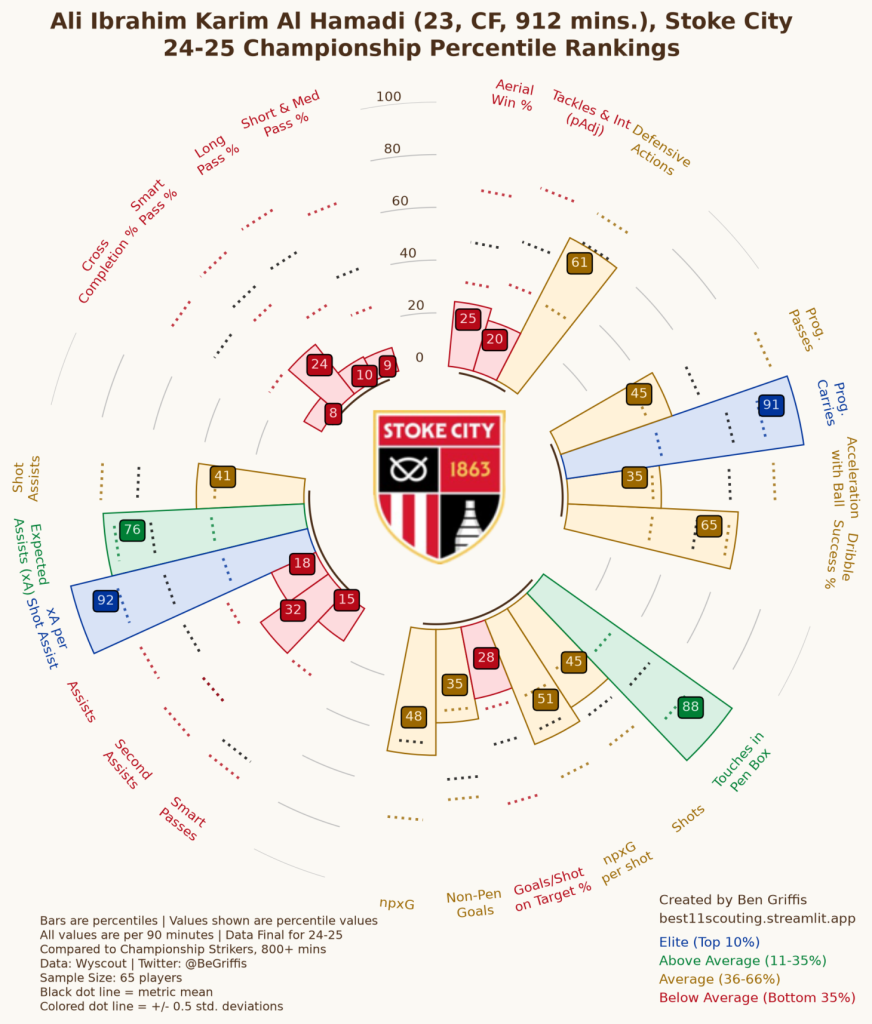
Woof.
Ipswich get relegated and Al-Hamadi’s loan to Stoke ends, so the 2025-26 season opens with both player and team in the Championship. It would not stay that way for long.
After making just one league appearance with Ipswich, Al-Hamadi was loaned to Luton Town in spite of already being injured when the deal was struck. He didn’t make his debut with the Hatters until Halloween, played just 34 minutes before the November international break, and promptly headed back to the training room upon his return until the end of January.
By the time he was fully fit, the team had — by necessity and understandably — found other options up top. He got stuck behind 36-year-old Nahki Wells. Between the injuries and depth chart blockers, he played just 413 minutes across 13 matches. He did score once.
Luton declined his purchase option, meaning he is back once again with Ipswich. It’s possible Al-Hamadi will find his form with the Tractor Boys this year, but as they won promotion back to the Premier League, it seems far more likely they’ll look to cut their losses and move on from him.
But, hey, that means he’s available!
So should the Loons sign him?
The answer seems like an obvious no, especially since FotMob and Sofascore disagree with futi’s assessment of his performance for Iraq against France. At that point, he’s being brought in on the back of a genuinely strong performance against Norway and back-to-back good seasons in League Two.
And yet. He’s the starting striker for a World Cup-caliber team, he’s still just 24, and as long as he’s healthy there’s no reason to believe he’ll have a repeat of last year. After two staccato seasons, he’s abslutely change of scenery candidate. There would seem to be ample upside if he can get back on track, so it’s a question of how likely it is that he ever does get back on track.
This comes down to logistics for me. He’ll require a nominal transfer fee, take an international slot, and will need his minutes carefully managed both in the sense of not giving him too many so he gets injured again and giving him enough to get him going consistently.
Meanwhile, Momo Dieng, Bongi Hlongwane, Mauricio Gonzalez, and even Marcus Caldiera are all up-to-speed already, know the team and league, and are also in need of MLS minutes to show what they can do. Al-Hamadi probably has the highest ceiling of all of them, but comes with the greatest risk as well.
Minnesota is currently in eighth place in the Western Conference, their margin for error is small, and points are at a premium. There’s a time to bring in high-upside lottery tickets, but this season isn’t one of them.