
I’m not usually one to react to one game, but last weekend’s 5-1 beatdown of San Jose validated a lot of what I’ve been thinking about the team as well as prompting some questions, so here we go.
Weird Formation/Arpeggi
All season, even when they were winning games, there was this sense that Minnesota was simultaneously trying to be the team they were last year since it was successful and also literally any other team since that one was boring and exhausting. Injuries played a big part of that, as did the fact that the team didn’t have a large amount of turnover, as did the fact that Cam Knowles only took over the job after the preseason had started and was rebuilding the tactics on the fly, but the end result was a team at war with itself.
Against the Quakes, the Loons came out in… well, FotMob and SofaScore called it a 3-4-1-2, MLS had it as a 4-4-2, and the team’s lineup diagram was definitively none of the above.
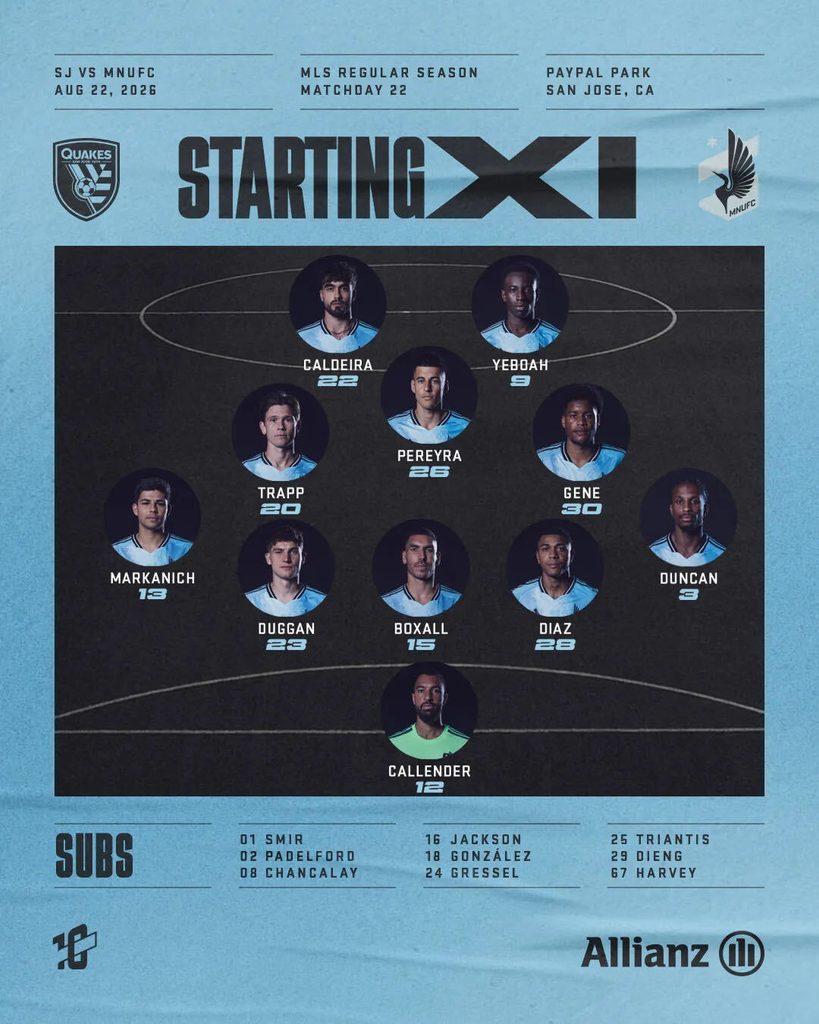
By personnel, that’s three centerbacks, two wingbacks, two central midfielders, an attacking midfielder, and a pair of forwards. So a 3-2-3-2? 5-3-2 but polygonal and aggressive? Whatever it was, it seemed to simplify and clarify responsibilities. When San Jose had the ball, they compressed effectively, when the ball turned over, they seemed to have a better-than-normal sense of where their teammates would be.
It isn’t lightyears different from the 3-4-3 they’ve mostly settled into, but whatever the tweaks were, they seemed to produce better play almost across the board. They seemed to both simplify and clarify each player’s role, allowing them to move more decisively and purposefully.
One thing it certainly enabled was Marcus Caldeira getting time as a second striker — oh boy do I wish I’d hit publish on my forthcoming “Hey, Marcus Caldeira should play as a second striker!” piece before this game — and I suspect we will see him in that role quite a bit going forward.
Rush, But Don’t Hurry
Every single goal the Loons scored last night came when they moved quickly. Joaquin Pereyra’s came as a result of sharp, one-touch passing; Kelvin Yeboah’s brace both came on fast breaks; Marcus Caldeira’s came from a high press, then him driving to the goal; and Mauricio Gonzales’ came off a set piece where he crashed the front post.
Minnesota has had trouble breaking down low blocks this season, not remotely a unique problem, but one that has just two solutions: Make the tactical and/or personnel changes necessary to figure it out or never let the block form in the first place. The Loons chose the latter and it worked superbly, playing to their strengths instead of highlighting their weaknesses for once.
From a player acquisition perspective, Minnesota has opted to bring in a lot of good players rather than a few great ones. When they play slow and bog down in the attacking third, they need someone – usually Pereyra and Yeboah – to do the things great players do, unlocking a defense that has settled into place. By going quickly and purposefully, Minnesota involves more of its talented players and keeps the defense from organizing.
Pereyra’s goal is a perfect example.
From the time the ball turns over to Angus Gunn’s despairing dive, four players touch the ball in just 12 seconds. Wil Trapp wins the ball at the 8:52 mark, Yeboah reaches the top of the box with the ball at 8:57, Pereyra receives the ball in the box from Anthony Markanich at 9:02, and at 9:04 the ball is in the net.
In terms of touches, Trapp wins the ball directly to Pereyra, who drives the ball forward to Yeboah. Once Yeboah’s movement is stopped by three San Jose defenders, he moves the ball quickly back to Pereyra, who hits the first time pass to Markanich. Markanich takes one touch before moving the ball back to Pereyra, who takes one touch to receive, one touch to steady, and one to tie the game.
At the point Pereyra hits his pass to Yeboah, San Jose has five behind the ball; they have six in the box when he turns to shoot. This isn’t quick movement in the fast-break sense that goals two and three were, it’s about moving the ball before the defense can set and maintaining spacing in the attacking third such that no defender was marking multiple attackers.
PayPal Planetarium
Speaking of space, oh boy did the Loons see a lot of it!
Owen Gene feasted on the open midfield of the Quakes, driving Minnesota’s attack forward through the middle. He freed up both wings to stay wide, which led to Yeboah’s first goal via Kyle Duncan, and used the unbalanced, retreating San Jose defense’s momentum against them by sliding a ball through to Yeboah for his second. Even on attacks that didn’t end in a goal, he pushed the tempo effectively and acted as a platform for Pereyra to create off.
On both of Yeboah’s goals, the space that Gene exploited and the time Yeboah needed to shoot were afforded to them by Caldeira. Minnesota has not often played with two strikers — Adrian Heath’s addiction to the 4-2-3-1 is well-established — and even when they have, they haven’t had a true second striker or false 9. More often, it was a way to change the point of attack and keep defenders from marking a single striker out of the game.
Through 155 MLS minutes and 31 Leagues Cup minutes, Caldeira looks like a bona fide, electrified false nine.
I want to reiterate: He has played 186 minutes. It is very stupid to make big sweeping judgments based on the equivalent of two games. The only reason I feel remotely comfortable doing it in this case is that I’m not looking at output — I do not believe he will continue to average four goal contributions every 180 minutes, even though that is what he’s doing right now — but behavior, which is more repeatable even as defenses adjust to him.
On both fast breaks and offensive sets, Caldeira was constantly in motion, pulling defenders away from the ball but staying close enough to warrant their attention. It’s thankless work. It’s absolutely critical and can be conspicuous in its absence, but it can live in the realm of the counterfactual. Had he not occupied a defender on Pereyra’s rabona, might there have been someone there to clear the ball off the line? Entirely possible, but there’s no way to know with certainty. It’s entirely reasonable to say he had a hand in the first four of Minnesota’s goals, even though he is only on the scoresheet for one of them.
If, and I want to underscore this again, IF that’s a role he’s excited to play and IF he continues to develop chemistry with Pereyra — whom he has already assisted three times, the same number of assists he had in 1300 minutes with MNUFC 2 — and Yeboah, Minnesota’s offense will start to click. The underlying numbers have been there all season. Caldeira has already shown the ability and mentality that make me believe he can unlock the finishing Minnesota has been lacking. I’m not the only one who is high on him.
All of that seems pretty rosy, right? Even with my typical hedging, it should be clear that Minnesota looked back to their April and May form using patterns that seem to be repeatable at least in theory. There are two substantial questions, however, keeping me from booking babysitters for a deep playoff run.
Was That About What Minnesota Did or What San Jose Didn’t Do?
San Jose was a juggernaut at the start of the year. They won nine of their first 10 games, and they looked great when they knocked the Loons out of the U.S. Open Cup. However, that was pretty close to the last time they looked good at all. Since returning from the World Cup break, the Quakes have taken a single point and conceded 18 goals in six games. They are bad.
Nothing said above about Caldeira creating space is wrong or intentionally overstated, but it’s entirely possible that San Jose’s utter lack of defensive structure made his results look better than his skill warranted. The same is true of Gene, who used the space he was given very well, but how much of that comes down to Quakes players leaving acres of space where they should not have?
Minnesota is likely neither as good as they were in April nor as bad as they have been since returning from the break. They’ve been wildly underperforming their expected performance. It’s possible a game like this was going to happen irrespective of the opponent and the Quakes simply made it very easy for them.
So: Is this repeatable?
This is the question I guarantee is echoing through the halls of Golden Valley and Blaine.
To be clear, the result is not consistently repeatable, but it doesn’t need to be if the formation and process continue to produce stability in the midfield and defense as well as consistent big chances in attack.
If this was a fun one-off before a return to the grave, Minnesota needs substantial help in the transfer window to even have a shot at making the playoffs. If they really did discover who they need to be, even against stiffer midfields, suddenly the team feels very different. There has always been plenty of talent on the team, but now they have a plan that fits that talent. They have more on the way with Nectarios Triantis already back to getting game minutes, and Nicolas Romero close behind. They’re still a few pieces short of where I might like them to be, but with both of their Designated Players looking up to that moniker, they’re back to being a team other teams don’t want to face irrespective of their seed at the end of the season.
The case against this being indicative of what Minnesota can do over the rest of the season is fairly obvious: That was unlike any Loons performance since Teemu Pukki beat the snot out of the L.A. Galaxy at the end of the 2023 season and San Jose is bad.
The case for it being the start of brighter days is two-fold, neither of which takes a massive leap of faith. First, the new-look formation did, in fact, clarify players’ responsibilities and they feel more comfortable and confident in execution. Second, Caldeira’s introduction into the lineup has created the space required for Yeboah and the Loons’ other attackers to finish their attacking chances more frequently.
Minnesota has been getting into good positions for weeks — we’ve been over this repeatedly — and not finishing their chances. A little more time and a little less stress would both make it more likely that they finally start doing it.
Saturday’s game against Orlando City will be a fascinating test for Minnesota. They’re on the opposite trajectory of the Quakes: They lost five their first six and conceded a staggering 23 in the process. Since returning from the World Cup with Antoine Griezmann in tow, however, they’ve been much better including shutting out Nashville in a 1-0 win and holding Cincinnati to a 1-1 draw.
Minnesota should approach the game in much the same way that they did against San Jose, but the OCSC midfield won’t be so easily bypassed. They’re not impenetrable and will be vulnerable to counterattacks, particularly down Griffin Dorsey’s wing, but they’ll give Minnesota a much stiffer test than the Quakes did.