In part one, I covered the players fully out of contract. This time, let’s look at the players Minnesota United can easily renew by picking up their option.
Jordan Adebayo-Smith (Option for 2027)
2026 marked the end of Adebayo-Smith’s three-year deal, which surprises me. I would have guessed he hadn’t been with Minnesota that long. He logged 502 minutes for MNUFC 2 and notched a pair of goals, but he’s so far down the depth chart, there’s little point to bringing him back for another year.
Verdict: Let him go
Marcus Caldeira (Options for 2027, 2028, 2029)
This is the easiest option decision on this list; this might be the easiest option decision the Loons have ever had.
Caldeira was a revelation this season. He scored seven goals in 688 minutes, none bigger than his game-winner over St. Louis City, and that undersells his impact. He played alongside Kelvin Yeboah as a second striker and created space where none had been before his emergence. He gave the team a different look off the bench. He was positively lethal with the ball at his feet.
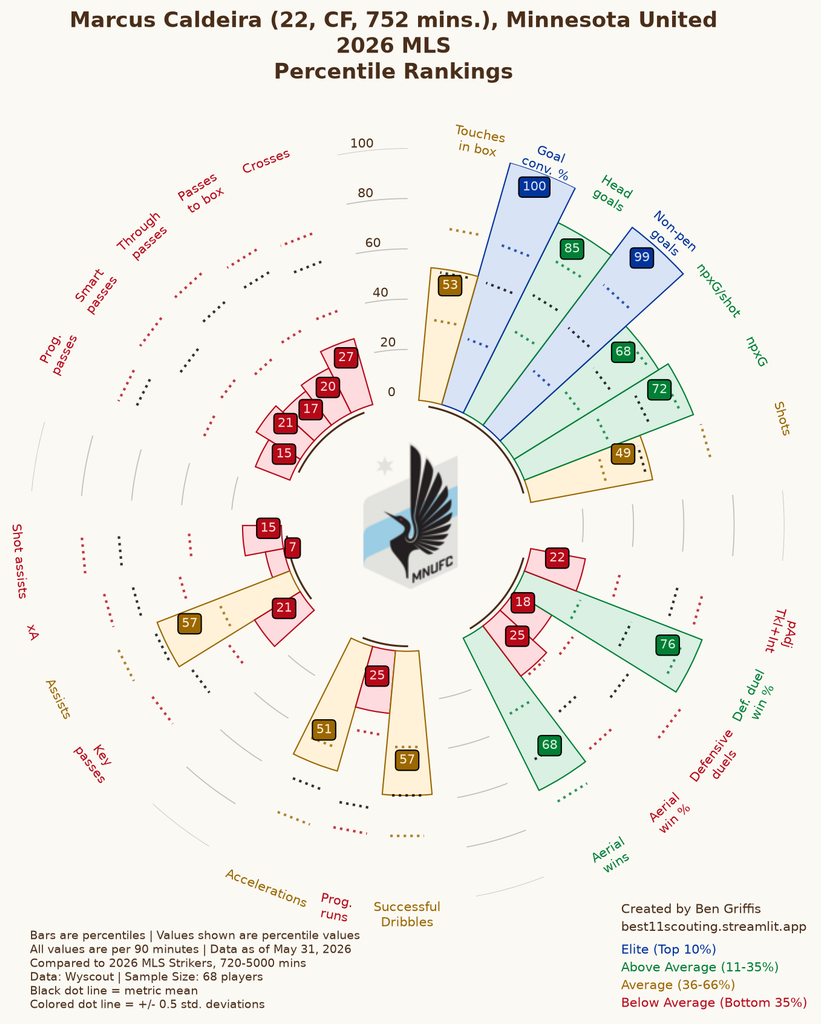
I realize I’ve been the one gassing up this particular bandwagon, but I do worry that he’ll have a slight regression next season and people will unfairly label him a one-season wonder. His ability to add value to the attack beyond just finishing off moves should make that less of an issue, but since so much of what he does is hard to quantify, it may be an issue.
Verdict: The only way Caldeira isn’t still on this team in 2029 is if he follows his fellow Canadian, Tani Oluwaseyi, to a big five league.
Kieran Chandler (Options in 2027, 2028)
Fun fact: The Loons were 2-0-0 this season when Chandler saw the field.
Chandler is in an interesting spot. He’s still a strong prospect, though his numbers with the 2s are less impressive than they otherwise might have been because he spent quite a bit of time on the first-team bench. In a different era of this team, we’d be talking about him as the future in a spot where the Loons have struggled to find consistency. The problem is, in this era, he’s behind Anthony Markanich, the most undroppable player on the team. That means a limit to his access to playing time unless Markanich gets hurt.
From a sheer logistical standpoint, there’s no reason for the Loons not to pick up his option. He’s still just 21, and I suspect the first-team practice time was valuable for him this season. But there will come a time within the next 18 months where Minnesota will need to have a clear picture on what they think his role is with this team going forward and trade him if they can’t see a path to consistent contribution for him.
Verdict: Another no-brainer pick-up, but harder conversations are coming. Could we see a USL Championship loan?
Mamadou Dieng (Options in 2027, 2028)
Brass tacks: 2026 was a bad year for Dieng. He started the year the clear #2 behind Kelvin Yeboah, struggled to make an impact, then found himself pushed down the depth chart by the eruption of Caldeira and the arrival of Maurice Malone… who also struggled to make an impact. Dieng didn’t make the Loons’ gameday roster after August 29, though he did play well for the 2s toward the end of their season.
But all the things that made him an interesting prospect in 2024 are still true today: He’s young, uses his body well, moves without the ball effectively, and had a strong goalscoring record before this year.
Nothing I saw from Malone this year tells me he’s about to run away with the third-string job and there’s a nonzero chance Minnesota sells Yeboah before the sprint season. For those two reasons alone, I would bring Dieng back but plan to loan him out unless Yeboah does indeed leave.
Verdict: 2027 is a put-up-or-shut-up year, but Minnesota can afford give Dieng a bit more time
Kyle Duncan (Option for 2027)
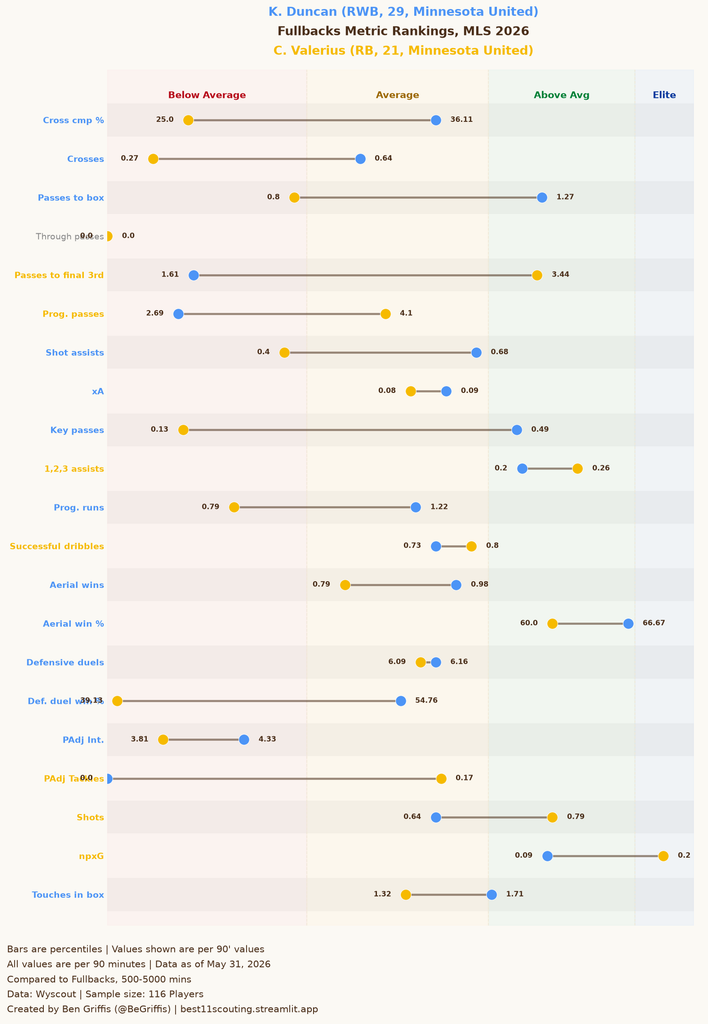
As the 2026 season was about to dawn, the bar lights came on. Duncan needed a ride home, Minnesota needed to not be alone, and a match was made. Honestly, it worked out fine. Duncan was average or a bit better in most of the ways Minnesota needed him to be, especially when the team was in a back five, which allowed him to press further forward without worrying about tracking back.
But it’s illustrative that one of the most notable changes that sent the Loons to the cusp of the playoffs is the arrival of Cherrion Valerius. The Curacao international is more mobile than Duncan, so the team was able to move to a back four and simplify the defensive scheme without sacrificing the attacking and crossing option Duncan presented. Going into 2027, there’s no question he’s the backup to Valerius.
Duncan grades out well in the head-to-head between the two, but I suspect we’ve barely scratched the surface of what Valerius can do once he settles in.
His $400,000 salary is hardly backbreaking, but when he also doesn’t really fit the scheme anymore, it doesn’t make a lot of sense to keep him. I don’t think it’s a huge mistake to keep him, given the lack of depth at right back, but I suspect the team can replace his production for less in the free agent market.
Verdict: Let him go or negotiate a lower deal if he’s willing to.
Britton Fischer (Options in 2027, 2028)
The 22-year-old started 27 matches for Hartford United in the USL Championship, including going 120 minutes in their playoff quarterfinal loss to Charleston. He’s a monster in the air, a good passer, and had a good all-around season for Hartford. There’s a valid question as to how exactly that translates to MLS — as Dieng exemplifies — but he did what the Loons likely hoped he would when they sent him out on loan.
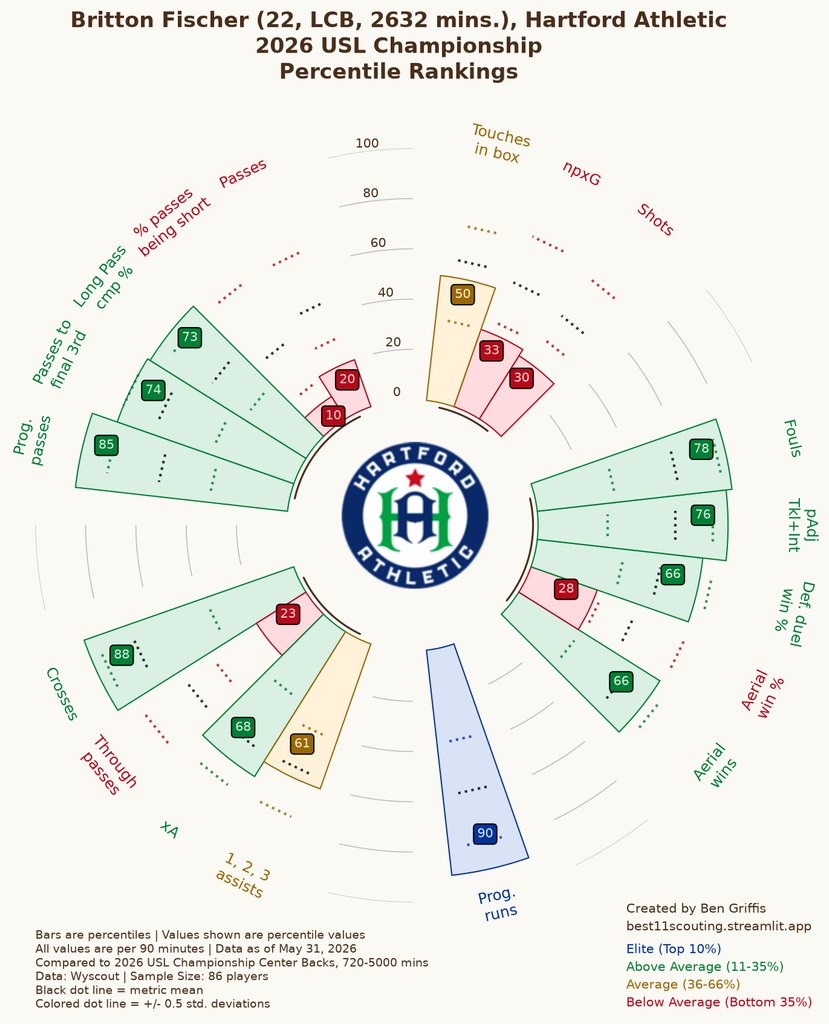
When Minnesota was playing a back five consistently, they needed all the center backs they could get. Assuming they’re staying in a back four, that’s less true, and with Morris Duggan having locked down one of the spots, there’s even less opportunity for a young player like Fischer to break through.
Much like Chandler above, there’s no reason to decline Fischer’s option. Even if the plan is for him to remain with Hartford next season, there’s no roster crunch that would force them to move on from him sooner than next year.
Long-term, I suspect Fischer’s future is closely tied to Nico Romero’s. If the former MLS 22 Under 22 member rediscovers his fitness, he’ll challenge Jefferson Diaz for starting minutes and keep Fischer away on loan. If the Loons choose to sell him, Fischer could end up staying with the team for depth.
Verdict: Keep him, send him out for another loan stint
Darius Randell (Options in 2027, 2028)
If Calderia is the easiest option to pick up on this list, Randell is barely a half-step more difficult. According to American Soccer Analysis, the 19-year-old was the 8th best player in MLS Next Pro last season. It’s not hard to see why!
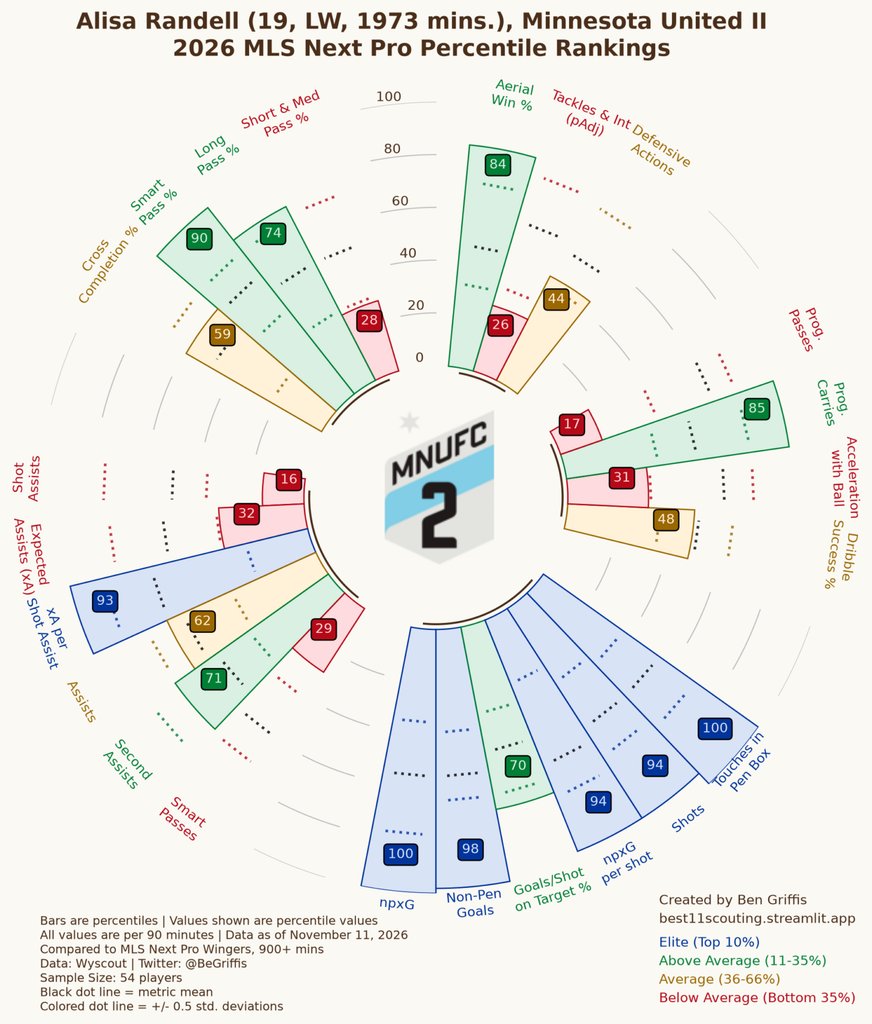
His game profiles as one that should translate exceptionally well to MLS proper. This is from around midseason, but still shows that he has the underlying performance characteristics of a well-above-average winger.
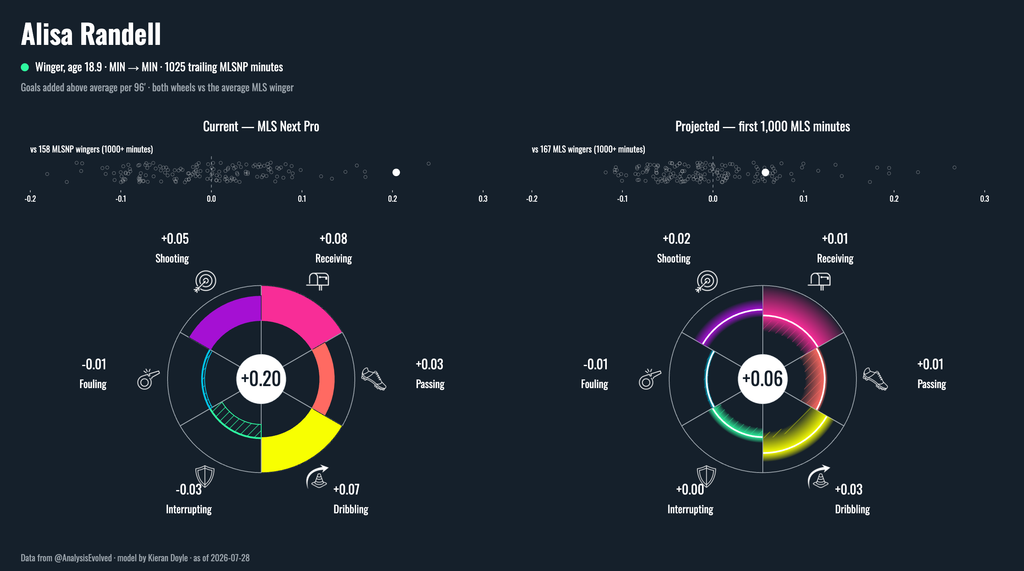
So the option is a no-brainer, the question is what the Loons do with their budding star. Another season in MLS Next Pro feels like a waste of development time, but a loan out means Minnesota is entrusting his progression to an outside coaching staff.
One thing to keep an eye on: Former Loons’ assistant Ian Fuller is now the head coach of Birmingham Legion, who have also taken other Loons loanees previously, so that may make Birmingham the perfect balance of increased competition and the right coaching staff.
Verdict: Yes, obviously
Peter Stroud (Option for 2027)
Minnesota liked Stroud enough to pay a transfer fee for him last season, and while 2026 was a lost season, that doesn’t make cutting bait on him the right move. His salary isn’t onerous, so they may as well bring him back to see if the things that made him attractive in the first place are still part of his game.
Verdict: Sure, why not. Hard to get too bothered either way after his injury-plagued 2026