Imagine knowing at the start of the season that when the regular season wrapped, Minnesota United would have:
A player tied for eighth in MLS goals this season (Kelvin Yeboah)
A player tied for fourth in big chances created and tied for the league lead in assists (Joaquin Pereyra)
A player in the top 20 of American Soccer Analysis’ holistic G+ measure (Anthony Markanich)
A top-10 keeper in goals prevented (Drake Callender)
A top-10 team attack as measured by expected goals
A league-average team defense as measured by expected goals allowed
A top-10 overall team performance as measured by G+
What would you guess their point total would be? Similar to last year’s 58? Perhaps even pushing 60 for the first time in team history? (Would you be suspicious that there was no mention of James Rodriguez?)
Would 44 points and the longest possible offseason even cross your mind?
Unexpected or entirely foreseeable, that’s where the 2026 lies in rest. No one I’ve spoken to with the club is happy about the outcome, but how surprised should any of us be that this team couldn’t put together a better season?
Throughout the season, the line from Cam Knowles, Josh Wolff, or nearly anyone else facing the media was that as frustrating as things were, they felt like there was enough good going on to believe that results would change soon. With the benefit of hindsight, we can see that was wrong, but we can also see why they believed it.
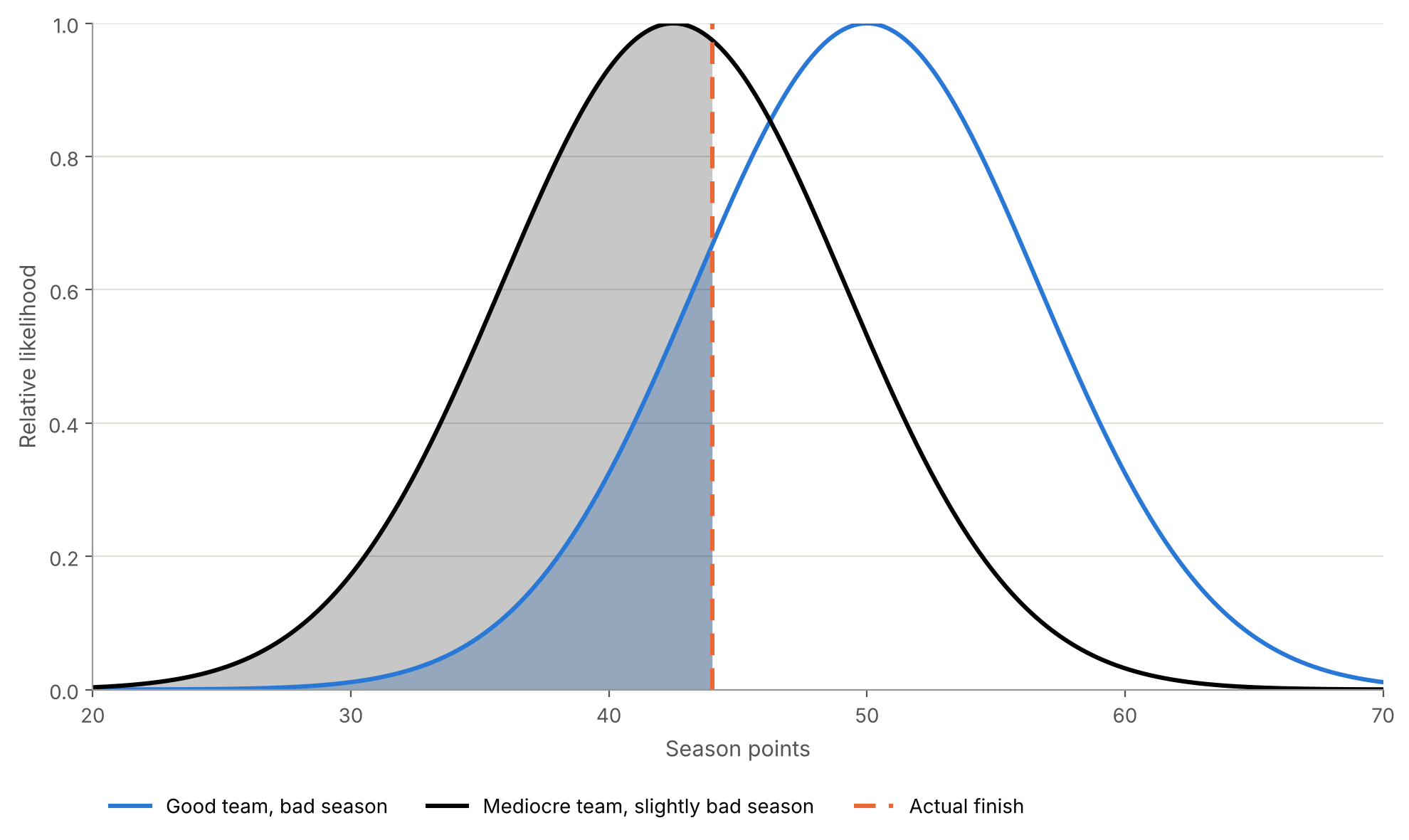
Even in MLS’ perilously short offseason, there will be time to relitigate the 2026 season, but between now and February 28, there is really only one question that matters: Which curve is Minnesota on?
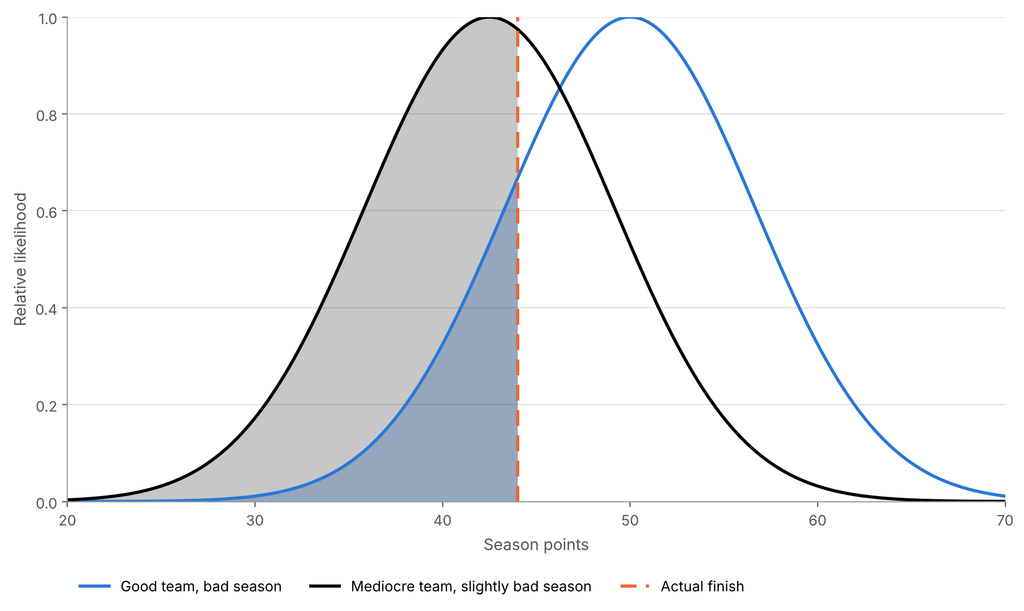
Each curve represents a distribution of outcomes — stylized and smoothed – for two versions of the same team: one that played relatively close to expectations based on its talent level and one that had a run of bad luck that only hits once or twice a decade.
No one wants to admit how much of a role luck plays in success, but it’s undeniable.This is not unique to sports, but it is particularly acute here. Admitting how much luck is involved over the course of a successful season risks cheapening the results, so it’s understandable that teams don’t do it in public. But if the myth persists in private, there is a risk of mistaking good fortune for repeatable success.
It’s counterintuitive that good teams and bad teams can end with the same number of points, but as anyone who has spent time with futi’s Centurions game can attest, superior talent and strategy aren’t enough to guarantee superior outcomes*. Especially in high-variance leagues like MLS, luck has a large impact on the final accounting. And, contrary to the platitude, there’s no guarantee that it evens out even over a season-long sample.
Minnesota believes they’re the blue curve, a good team that hit headwinds and ended up producing an incredibly subpar season. The other option, represented by the black curve, is still a below-average outcome but less so. No matter what, it’s a disappointing season, but understanding how unlikely this was is critical to ensuring that this was a one-year dip and not a sustained dive.
If they’re right and this is close to as bad as this collection of talent could do, next season should be much better without needing to be a remarkable outlier in the other direction. For perspective, if Minnesota is indeed the blue-curve team and they’d had good luck instead of bad, they would have finished on 56 points, either in second or third place in the Western Conference.
If they’re wrong, this result was actually fair, and they need to do the hard work of figuring out which players that seem like solid fits are actually holding the team back.
The end of the season makes this distinction even more difficult and even more important. Over the last five games of the season, only Columbus was better than Minnesota, and while some of the draws were frustrating, finishing the year unbeaten in seven is impressive — especially when they could have just rolled over and died instead of fighting until the end.
If Minnesota is the blue-curve team, then that stretch represents a regression to their mean, and the fact that they can start the same outfield 10 on February 28 is a huge boon. If they’re the black team, that stretch is distracting noise that makes the incoming sporting director’s job much more difficult.
*When I finally broke the 100 point mark for MLS, it was with a team that had absolutely no business getting anywhere close to that.