
Despite being connected with attacking midfielders all transfer window, Minnesota’s only deadline day acquisition was at the other end of the pitch. For the second window in a row, the team pursued NAC Breda’s 20-year-old right back Cherrion Valerius, and this time they got it done.
Strictly speaking, the deal is a loan through the end of 2026 with a purchase option that becomes mandatory if Valerius hits a minimum number of appearances. That structure should give away the game: Both sides view this as a full transfer but the fee will hit after there’s more clarity around the new CBA and salary cap and when some roster machinations have resolved.
Minnesota has 11 games remaining, which is hardly enough time to make an impression and makes you wonder how low the appearance trigger is. Additionally, Valerius is still working on getting his visa and will miss Wednesday’s home game against Dallas at the very least and likely Saturday’s in St. Louis as well. This is a move made with an eye to the future, no matter what the contract technically says.
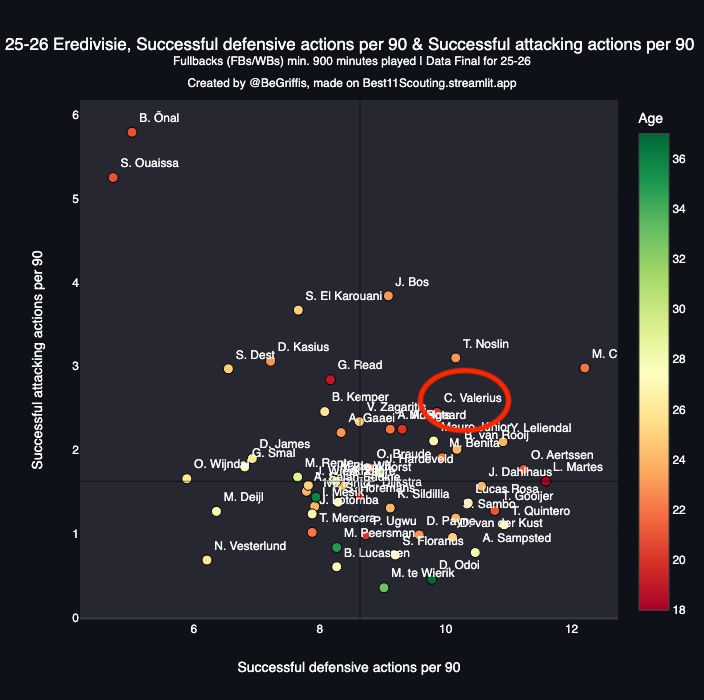
One of the things I like most about Valerius is his two-way play. Below is a plot of fullbacks and wingers average successful offensive and defensive actions per 90, there are certainly players who defend more and a few who attack more, but just two that did both:
Digging deeper into his offensive contributions, it’s clear that crossing is a huge part of Valerius’ appeal to the Loons. They haven’t had a truly great crosser since Romain Metanire left the club, and while they don’t have a Peter Crouch-esque target striker, Valerius pumping crosses in from the right should give Anthony Markanich a steady stream of the back-post chances he feasts on.
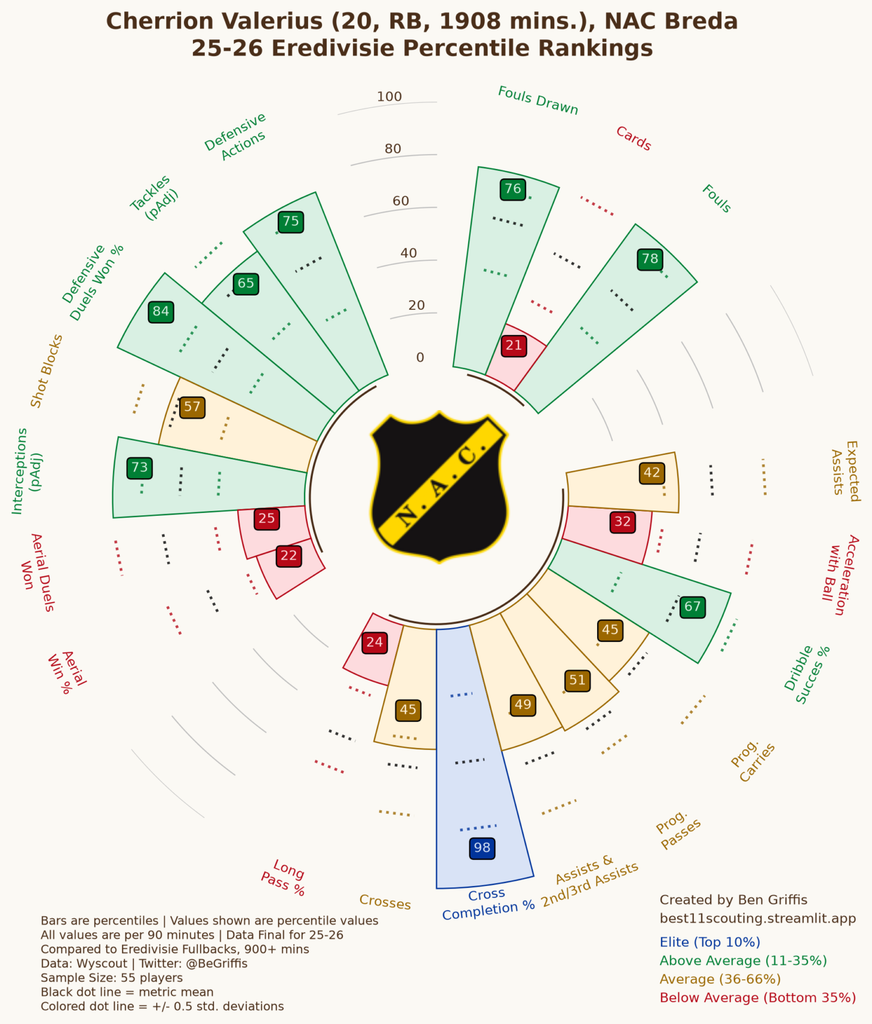
I’m loath to put too much stock into Valerius’ middling progressive actions and low expected assists because of how bad NAC Breda was offensively last year. Valerius may or may not be capable of leading a breakout or picking a progressive pass, but a team that mustered a paltry 35 goals in 34 games has much larger issues holding them back.
Progression is one of two areas I believe Minnesota thinks he can improve in and for which they have a plan to help him do it; if they’re right, Valerius could look like a bargain before long. The other area is his bafflingly low aerial duel win rate. It’s not the most crucial skill for a fullback, but Valerius is 6’4” so the tools are there for him to be much better in the air than he is.
In addition to right back, he also logged significant minutes at center back, where that lack of prowess in the air is a genuine liability. The Loons won’t need him to spend time at center back unless they get obliterated by injuries, but coaching him up to even mediocrity would make him a much more viable option than he is now.
It’s hard to be mad about this deal: Valerius is young, has both upside and experience, and is in a position of need, even if the team picks up Kyle Duncan’s option through the sprint season. A report from Breda hints that the overall deal — loan fee plus purchase option — is $1-2 million, still less than the Loons offered in January and an extremely reasonable fee for a starting-caliber player. Assuming, that is, that Valerius is indeed a starting-caliber player.
Good players on bad teams are the hardest for me to evaluate. Would his attacking numbers look better if he’d had an attacking midfielder of Joaquin Pereyra’s quality? NAC Breda’s leading scorers each had five goals last season – that would be forward Sydney van Hooijdonk and left back Boy Kemper; it’s never a good sign when no one can outscore a fullback — or would he look like a more stalwart defender if the team hadn’t constantly been chasing the game? It’s counterfactual, so impossible to know for sure, but playing for one of the worst teams in a good league is going to skew how a player looks on paper.
According to Opta’s domestic league rankings, the Eredivisie is close to the same quality as LigaMX and a bit better than MLS. That doesn’t guarantee that Valerius will adapt seamlessly to MLS, but he has played against plenty of high-quality competition and the league is a fairly open one. The pace of MLS attackers can be part of the culture shock for players arriving from Europe, but Valerius should struggle less with that than players coming from, say, Greece.
There’s nothing wrong with this deal. Right back has been an almost constant sore spot for Minnesota and Valerius could very well step in to a better lineup, find production that was missing at Breda, level up a few skills, and lock down the spot for the next half-decade. There’s a clear path to that happening, not one that depends on pie-in-the-sky wishcasting like “Luis Amarilla will score 25 goals just like he promised.”
Even so, he’s far enough from a sure contributor to make me a bit wary of the deal, especially if the team doesn’t pick up Duncan’s 2027 option. He’s cost-effective, but as the Loons have proven over and over again, cost-effectiveness is only a virtue if the production level is high.